

Calculate your electric fireplace’s running cost by multiplying its wattage by your local electricity rate, then dividing by 1,000. A typical 1,500-watt unit running at $0.13 per kilowatt-hour costs roughly $0.20 per hour, or about $6 monthly if used two hours daily.
Check your fireplace’s heat settings before assuming maximum costs. Most electric fireplaces offer flame-only modes that use just 3-8% of full power, letting you enjoy ambiance for pennies while saving heat for when you truly need it.
Compare your electric fireplace costs against central heating by calculating the per-room expense. Running an electric fireplace in your living room typically costs $30-50 monthly during winter, while heating your entire home through central systems can exceed $200, making zone heating a smart eco-friendly strategy.
Maximize efficiency by using programmable timers and thermostats to prevent unnecessary runtime. Running your fireplace during off-peak electricity hours when available can reduce costs by 20-40%, and keeping your space well-insulated ensures the warmth you’re paying for actually stays where you need it.
Understanding these practical costs transforms electric fireplaces from a luxury question mark into a calculable lifestyle investment. Whether you’re drawn to the cozy ambiance or supplemental heating benefits, knowing your actual expenses empowers confident decisions about bringing warmth into your home without budget surprises.
Breaking Down the Numbers: What You’re Actually Paying
The Simple Math Behind Your Bill
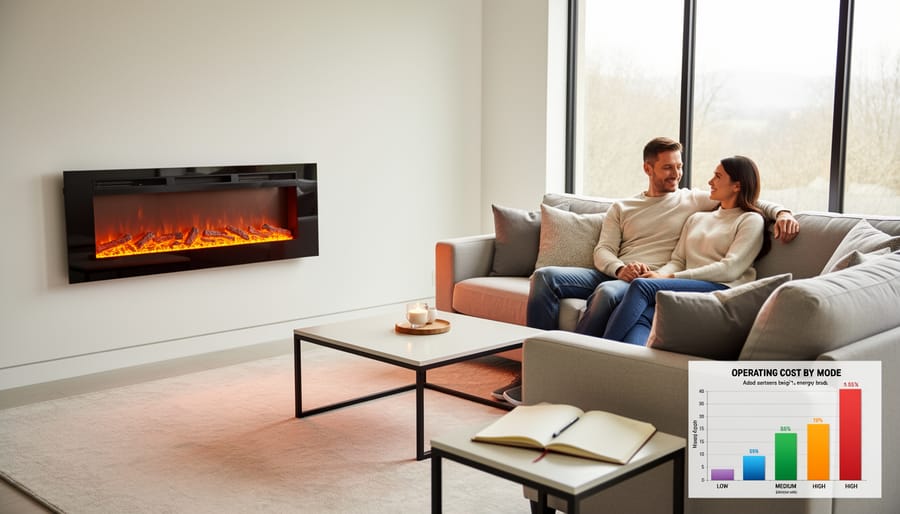
Calculating what your electric fireplace will cost to run is easier than you might think. You don’t need to be a math whiz – just follow this simple formula that breaks down your operating costs into real dollars and cents.
Start with three pieces of information: your fireplace’s wattage (usually between 750-1,500 watts), your electricity rate per kilowatt-hour (check your utility bill – the national average is about $0.13 per kWh), and how many hours you plan to use it.
Here’s the formula: (Wattage ÷ 1,000) × Hours Used × Rate per kWh = Cost
Let’s walk through a real-world example. Say you have a 1,500-watt electric fireplace, and you want to run it for 5 hours on a cozy evening. Your electricity rate is $0.13 per kWh.
First, convert watts to kilowatts: 1,500 ÷ 1,000 = 1.5 kW
Next, multiply by hours used: 1.5 kW × 5 hours = 7.5 kWh
Finally, multiply by your rate: 7.5 kWh × $0.13 = $0.98
That’s less than a dollar for an entire evening of warmth and ambiance! To estimate monthly costs, simply multiply your daily usage by 30. In this example, using your fireplace 5 hours daily would cost roughly $29 per month.
This straightforward calculation empowers you to make informed decisions about your home’s comfort while keeping energy efficiency in mind. Remember, many electric fireplaces offer adjustable heat settings, so you can reduce costs by using the flame-only mode for ambiance without the heating expense.
What Your Local Electricity Rate Means for You
Your electricity rate plays a starring role in determining what you’ll actually spend to enjoy your electric fireplace. While we’ve been using 13 cents per kWh in our examples, your local rate might tell a different story.
Finding your rate is simple: check your utility bill for the cost per kilowatt-hour, usually listed in the summary section. If you can’t locate it, a quick call to your utility company or visit to their website will get you the answer.
Regional differences can be dramatic. West Coast residents, particularly in California, often pay 20-30 cents per kWh, which means running that 1,500-watt fireplace could cost around 30-45 cents per hour instead of our baseline 20 cents. Meanwhile, folks in the Pacific Northwest or parts of the South might enjoy rates as low as 9-11 cents per kWh, bringing hourly costs down to just 14-17 cents.
These variations matter when you’re calculating your monthly budget. A Seattle homeowner running their fireplace four hours daily might spend around $17 monthly, while the same usage in San Diego could total $40. Understanding your local rate helps you make informed decisions about how this eco-friendly heating solution fits into your lifestyle and budget.
Heat vs. Ambiance: The Two Modes That Change Everything
Flame-Only Mode: Your Budget-Friendly Option
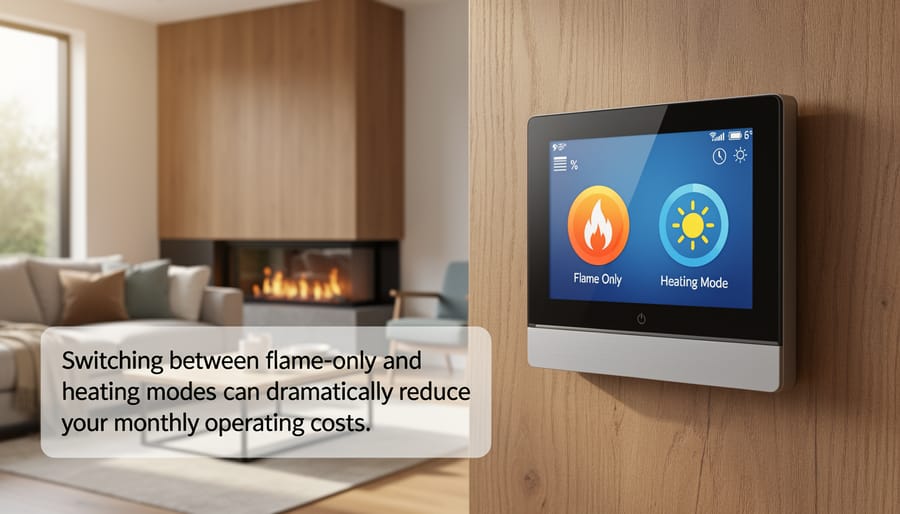
Here’s the beautiful secret about electric fireplaces: you can enjoy the cozy ambiance without spending practically anything. When you run your electric fireplace in flame-only mode, you’re using just 5-10 watts of electricity—about the same as a nightlight or smartphone charger.
Let’s put that into perspective. At the national average of $0.16 per kWh, running the flames alone costs less than a penny per hour—typically around $0.001 to $0.002 hourly. That means you could enjoy the flickering glow every evening for an entire month and spend roughly $0.30 to $0.60. It’s one of the most budget-friendly ways to create atmosphere in your home.
This mode makes perfect sense during shoulder seasons when you want visual warmth without actual heat, or in already-comfortable rooms where you’re simply looking to enhance the ambiance. It’s also ideal for entertaining guests or creating a romantic setting without worrying about your energy bill. Many homeowners discover this becomes their go-to setting during spring and fall evenings, proving that sometimes the most economical choice is also the most charming. Think of it as guilt-free ambiance that supports an eco-friendly lifestyle while keeping your budget intact.
Full Heat Mode: When Warmth Comes at a Price
When you flip your electric fireplace to full heat mode, you’re tapping into its true heating potential—but it’s worth understanding exactly what that means for your wallet. Most electric fireplaces offer two heat settings: a lower 750-watt option for gentle warmth and a full 1,500-watt setting for maximum coziness on those chilly winter evenings.
Let’s break down the real numbers. Using the national average electricity rate of $0.16 per kilowatt-hour, running your electric fireplace on the lower 750W setting costs about $0.12 per hour. That translates to roughly $0.90 for an eight-hour day, or around $27 monthly if you’re using it daily. Not too shabby for supplemental warmth in your favorite room.
Switch to the full 1,500W setting, and you’re looking at approximately $0.24 per hour. Run it for those same eight hours, and you’ll spend about $1.92 daily, which adds up to roughly $58 per month with regular use. While that’s double the lower setting, it’s still considerably less expensive than heating your entire home with central heating when you’re only using one room.
Here’s where the lifestyle element comes into play: most homeowners don’t run their electric fireplaces continuously at full blast. You might use high heat for a couple of hours in the evening to warm up your living space, then switch to the lower setting or just enjoy the flame effect without heat. This flexible approach not only saves money but also aligns with eco-friendly heating practices by reducing energy consumption while maintaining comfort.
Think of it as zone heating that works with your lifestyle rather than against your budget.
Size Matters: Matching Your Fireplace to Your Space
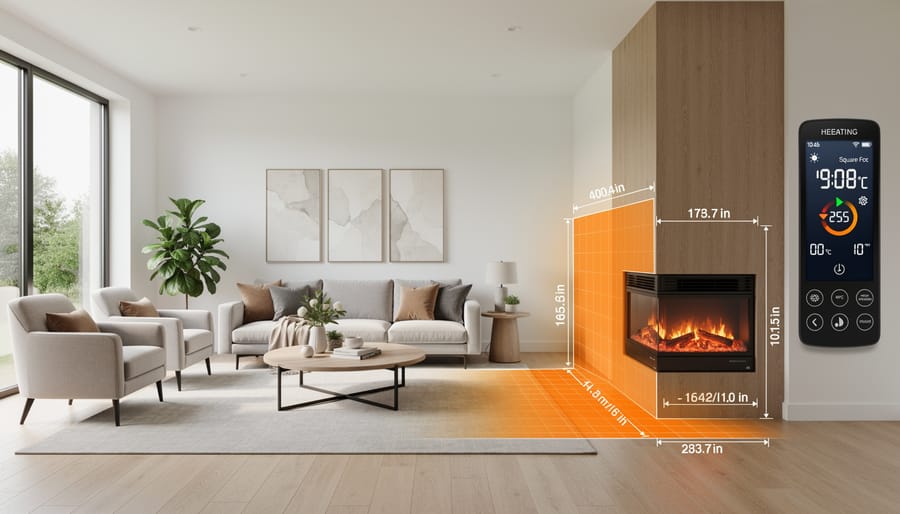
The Square Footage Rule Every Owner Should Know
Choosing the right size electric fireplace isn’t just about aesthetics—it directly impacts your running costs. The industry standard recommends 10 watts per square foot for effective heating. This simple guideline helps you avoid the inefficiency of running an oversized unit or the discomfort of an underpowered one constantly working overtime.
Let’s break this down with real-world examples. A cozy 150-square-foot bedroom needs approximately 1,500 watts of heating power. Most standard electric fireplaces operate at 1,500 watts, making them perfect for spaces like bedrooms, home offices, or dens. For a 300-square-foot living room, you’re looking at 3,000 watts—easily managed by running two units or choosing larger models designed for open-concept spaces.
Here’s where smart sizing saves you money. An appropriately sized fireplace reaches your desired temperature faster and cycles off more frequently, reducing continuous power draw. Infrared electric fireplaces excel at this efficiency, heating objects directly rather than just warming air, which means they often perform effectively at slightly lower wattages than the 10-watt rule suggests.
Before purchasing, measure your space and calculate accordingly. A 200-square-foot den needs 2,000 watts, while a compact 100-square-foot sunroom requires only 1,000 watts. This calculation becomes your baseline for estimating monthly costs using the formulas we’ve discussed. Remember, proper sizing isn’t about maximum power—it’s about matching capacity to your space for optimal comfort and cost-efficiency.
Why Oversizing Costs You More Than Just the Purchase Price
Buying an oversized electric fireplace might seem like a smart investment, but it’s actually one of the costliest mistakes you can make. When you install a 1,500-watt unit in a small 150-square-foot room that only needs 750 watts, you’re essentially paying to overheat your space and waste energy.
Here’s the reality: an oversized unit will heat your room too quickly, causing you to turn it down or off more frequently, which disrupts the cozy ambiance you’re trying to create. Even worse, many homeowners compensate by running their oversized fireplace on high heat for short bursts rather than maintaining a steady, efficient warmth. This cycling wastes approximately 20-30% more energy than a properly-sized unit running consistently.
The numbers tell the story. An oversized 1,500-watt fireplace running at full capacity for just 4 hours daily costs around $20 monthly, while a right-sized 1,000-watt unit achieving the same comfort level costs about $13. That’s $84 in unnecessary expenses each year, not counting the higher upfront purchase price for larger models.
Whether you’re planning a built-in electric fireplace or a freestanding option, proper sizing ensures both comfort and cost-effectiveness, creating the perfect balance between ambiance and eco-friendly heating efficiency.
Insulation and Heat Loss: The Hidden Cost Factor
Your electric fireplace doesn’t operate in a vacuum. The reality is that poor insulation, high ceilings, and drafty windows force your unit to work harder and longer to maintain comfort, directly impacting your monthly costs. A poorly insulated room can increase runtime by 30-50%, turning an economical heating solution into an energy drain.
Think of it this way: heating a well-insulated 200-square-foot room might cost $30 monthly, while the same room with drafty windows could easily reach $45-50. Simple improvements like weatherstripping doors, adding thermal curtains, or sealing gaps around windows can dramatically reduce how often your fireplace cycles on. Cathedral ceilings also pose challenges since heat naturally rises, meaning you’ll need more wattage or longer runtime to feel cozy at floor level. Before calculating your fireplace’s operating costs, consider your room’s thermal efficiency. Small eco-friendly upgrades to your home’s envelope often deliver the biggest savings, making your electric fireplace work smarter, not harder.
Real-World Cost Scenarios: What to Expect Each Month
The Evening Ambiance User
If you’re drawn to the cozy glow of flickering flames but don’t need the heat, you’ll love this scenario. Running your electric fireplace in flame-only mode is incredibly economical, typically consuming just 50-100 watts—about the same as a standard light bulb.
Let’s break down the numbers: If you enjoy 3-4 hours of ambiance each evening using 75 watts, you’re consuming approximately 0.3 kWh per night. At the national average of $0.16 per kWh, that’s roughly $0.05 per evening, or just $1.50 per month. Even if you run it every single day for a year, you’re looking at under $20 annually.
This makes electric fireplaces an eco-friendly lifestyle choice for creating atmosphere without the environmental impact or expense of traditional wood-burning options. You get all the visual warmth and romantic ambiance for less than the cost of a single latte each month—perfect for unwinding after work, hosting dinner parties, or simply enjoying quiet evenings at home.
The Supplemental Heat Strategist
Here’s a smart strategy that transforms your electric fireplace into a money-saving heating companion. Instead of warming your entire home to 72°F, try lowering your central thermostat to 68°F and using your electric fireplace to create a cozy zone in your most-used room.
Let’s look at the numbers. Running a 1,500-watt electric fireplace for 6 hours daily costs approximately $27 per month (at $0.15 per kWh). Meanwhile, lowering your thermostat by just 3-4 degrees can reduce your heating bill by 10-15 percent. For a home with a $200 monthly heating bill, that’s $20-$30 in savings, essentially offsetting your electric fireplace costs.
This approach aligns beautifully with eco-friendly heating practices, as you’re consuming less energy overall while maintaining comfort where it matters most. The real win comes from zoned heating: why heat empty bedrooms when you’re spending your evening in the living room? Your electric fireplace becomes both a lifestyle element that enhances ambiance and a practical tool for reducing your carbon footprint. Many homeowners find this supplemental approach actually saves them $10-$40 monthly during peak heating season while enjoying enhanced comfort.
The All-Day Comfort Seeker
If you’re planning to use your electric fireplace as your go-to heating solution throughout the day, understanding the long-term costs becomes essential for your budget planning. Running an electric fireplace for 8-10 hours daily can significantly impact your monthly energy bill, but the good news is that the costs remain predictable and manageable.
For all-day comfort seekers, let’s break down a realistic scenario. A typical 1,500-watt electric fireplace running on full heat for 8 hours daily will consume approximately 12 kilowatt-hours per day. At the national average electricity rate of $0.14 per kWh, that translates to about $1.68 daily, or roughly $50 monthly during peak heating season.
However, you can dramatically reduce these costs through smart usage. Many homeowners discover that running their electric fireplace in flame-only mode during mild days costs just pennies per hour, allowing them to enjoy the ambiance without the heating expense. During colder months, consider using the thermostat feature to cycle the heat on and off automatically, which can cut your consumption by 30-40 percent compared to continuous operation.
Seasonal considerations matter too. Your October and April usage will likely cost less than January and February, as you’ll need less intensive heating during shoulder seasons.
Smart Strategies to Slash Your Operating Costs
The Thermostat Dance: Zone Heating Done Right
Here’s the secret to maximizing your electric fireplace savings: think of it as a dance partner with your central heating. The most effective zone heating solutions involve lowering your whole-house thermostat while warming the spaces you actually use.
Try this strategy: drop your central heating by 5-7 degrees (from 70°F to 63-65°F) and run your 1,500-watt electric fireplace in your primary living area. With natural gas averaging $1.50 per therm nationally, heating your entire 1,500 square foot home costs roughly $3-4 daily. By reducing your thermostat and heating just one 300 square foot room with your electric fireplace, you could save $1.50-2.00 per day, even accounting for the fireplace’s $0.18 hourly operating cost.
The magic happens when everyone gathers in the cozy fireplace room during evenings and weekends. You’re creating an inviting atmosphere while your furnace takes a well-deserved break. This lifestyle-friendly approach to eco-conscious heating means your electric fireplace essentially pays for itself through reduced central heating costs, all while delivering the ambiance you love.

Timer Tactics and Usage Habits That Save Money
Smart timer habits can dramatically reduce your electric fireplace operating costs without sacrificing comfort. Consider installing a programmable thermostat or smart plug to automatically shut off your fireplace when you’re sleeping or away from home. Many homeowners waste money running their units continuously, even when they’re not enjoying the warmth and ambiance.
Set your fireplace to activate 30 minutes before you arrive home from work, creating a cozy atmosphere exactly when you need it. During evening relaxation, use the flame-only mode for visual appeal without heating costs—this typically uses just pennies per hour compared to full heat mode.
Avoid the common mistake of heating empty rooms. If you’re moving between spaces, take advantage of your fireplace’s portability or zone heating capabilities to warm only occupied areas. Weekend mornings are perfect for fireplace use, while weekday afternoons when everyone’s away represent pure waste.
For optimal savings, limit high-heat settings to 2-3 hour intervals rather than all-day operation. This conscious approach to timing transforms your electric fireplace from an energy drain into an eco-friendly heating solution that enhances your lifestyle while respecting your budget and environmental values.
Features That Pay for Themselves
Modern electric fireplaces come equipped with smart features designed to slash your energy bills while maintaining that cozy ambiance you love. Adjustable thermostats are game-changers, allowing you to set precise temperatures and prevent wasteful overheating. When your room reaches the desired warmth, the unit automatically cycles off, ensuring you’re not burning through electricity unnecessarily. If your fireplace keeps shutting off, it’s likely this efficient thermostat doing its job.
Eco-modes take efficiency further by optimizing power consumption based on room conditions, sometimes reducing energy use by up to 30%. LED flame technology is another standout feature that brings authentic flickering flames without the heat or high cost, using mere pennies worth of electricity per day. Many homeowners enjoy the visual ambiance year-round using just 3-5 watts for the LED display alone.
Timer functions let you program operating hours, preventing those “forgot to turn it off” moments that inflate bills. These thoughtful features transform your electric fireplace from a simple heating appliance into an eco-friendly solution that pays dividends month after month.
Electric vs. Gas vs. Wood: The True Cost Comparison
When Electric Makes the Most Financial Sense
Electric fireplaces shine brightest in your wallet when you’re looking for flexibility without the financial commitment of traditional heating. The most compelling advantage? Zero installation costs for plug-and-play models. While gas or wood fireplaces can set you back $2,500 to $10,000 in electric fireplace installation expenses alone, most electric units simply need an outlet.
The real magic happens with supplemental heating strategies. Instead of heating your entire home to 72 degrees, you can lower your central thermostat to 65 and use an electric fireplace to warm the room you’re actually using. This zone heating approach often reduces overall energy bills, even when factoring in electricity costs. A family room electric fireplace running 4 hours nightly typically costs less than maintaining whole-house heating at higher temperatures.
Maintenance savings add up beautifully over time. Forget about annual chimney cleanings, gas line inspections, or wood ash disposal. Electric fireplaces require minimal upkeep beyond occasional dusting, saving you hundreds in annual maintenance fees.
They’re also perfect for renters or those in apartments where traditional fireplaces aren’t options. You get instant ambiance and supplemental warmth without renovation headaches or landlord negotiations.
Consider electric fireplaces your most economical choice when you value installation flexibility, prefer eco-friendly heating solutions without combustion byproducts, or want to create cozy zones throughout your home without the infrastructure demands of gas or wood alternatives.
The Eco-Friendly Cost Equation
Beyond the dollars and cents on your electricity bill, electric fireplaces offer a refreshing environmental advantage. Unlike wood-burning options that release particulate matter and carbon emissions directly into the air, electric models produce zero on-site pollution. This makes them a naturally cleaner choice for both your indoor air quality and the environment.
The sustainability story gets even better when you pair your electric fireplace with renewable energy sources. If your home uses solar panels or you’ve switched to a green energy plan from your utility provider, you’re essentially running your fireplace on clean power. This combination transforms your cozy evenings into truly guilt-free moments of warmth and ambiance.
Consider the broader picture too. Electric fireplaces eliminate the need for chimney maintenance, reduce deforestation concerns, and require no fuel transportation. While the electricity they use does have an environmental footprint depending on your local power grid, their overall efficiency means you’re maximizing every watt consumed. As our electrical grids continue incorporating more renewable sources nationwide, the environmental benefits of electric heating solutions will only improve over time, making your investment increasingly eco-friendly with each passing year.
The beauty of electric fireplaces lies in their predictability. Unlike fluctuating heating oil prices or unpredictable gas bills, you can calculate exactly what your cozy evenings will cost before you even plug in your new fireplace. Armed with the simple formulas we’ve covered, you’re now equipped to estimate your specific operating costs based on your local electricity rates, room size, and heating needs.
Remember, the key to maximizing both comfort and cost-efficiency is strategic use. Running your electric fireplace as a zone heater in the rooms you actually occupy, rather than heating your entire home, can lead to significant savings. And when you just want ambiance without the heat, most models let you enjoy the flickering flames for pennies per evening.
Whether you’re considering your first electric fireplace or optimizing your current setup, take a few minutes to run the numbers for your unique situation. Factor in your local electricity rate, typical usage patterns, and the size of the space you want to heat. You might be pleasantly surprised at how affordable supplemental heating can be.
Ultimately, creating a warm, inviting home isn’t just about cutting costs to the bare minimum. It’s about making smart, sustainable choices that bring comfort and joy to your daily life. An electric fireplace, when properly sized and thoughtfully used, offers you both the practical benefits of controlled heating costs and the invaluable warmth of a welcoming hearth.