

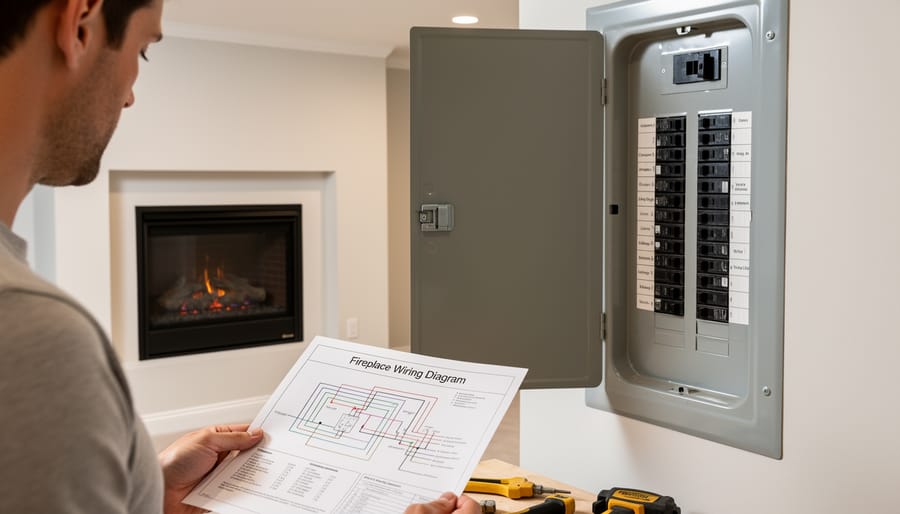
Examine your electric fireplace’s manual first to identify whether you have a standard 120-volt plug-in model requiring only a nearby outlet, or a hardwired 240-volt unit demanding direct connection to your home’s electrical panel. Most electric fireplaces operate on standard household current and simply plug into existing outlets, making installation remarkably straightforward for homeowners—but understanding the wiring diagram ensures you’ve met amperage requirements and prevents circuit overloads that could trip breakers or create safety hazards.
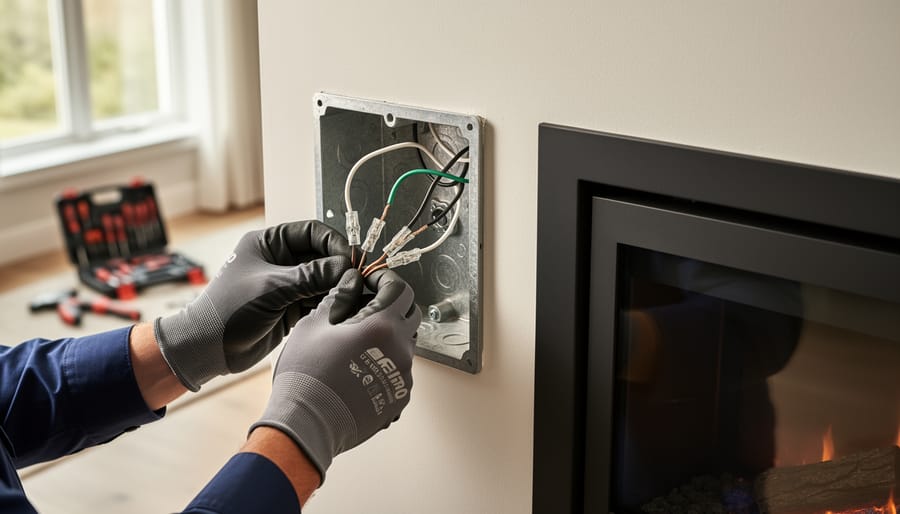
Locate the diagram typically found on the unit’s back panel or in the installation guide, where you’ll see clearly marked wire colors: black for hot, white for neutral, and green or bare copper for ground. These color codes are universal safety standards that protect you from electrical shock and fire risks when properly connected.
Verify your circuit can handle the electrical load by checking the fireplace’s wattage rating—most draw between 1,500 and 4,600 watts—and comparing it against your circuit breaker’s capacity, ensuring you’re not exceeding 80 percent of the breaker’s rating to maintain safe, efficient operation.
Recognize when professional help is essential: if your installation requires running new circuits, upgrading electrical panels, hardwiring into wall systems, or if you feel uncertain about any step, hire a licensed electrician. While electric fireplaces offer eco-friendly heating solutions without the complexity of gas lines or chimney installations, electrical work still demands respect for safety codes and proper technique. Understanding your wiring diagram empowers informed decisions about whether this lifestyle-enhancing addition is a weekend DIY project or requires professional expertise.
Understanding Electric Fireplace Power Requirements
Standard vs. High-Powered Models
When choosing an electric fireplace, understanding the difference between standard and high-powered models helps you make the right decision for your home and lifestyle.
Standard 120V plug-in models are the most common choice for homeowners, and for good reason. These units simply plug into any regular household outlet, making them incredibly convenient and versatile. They typically draw between 1,200 to 1,500 watts, which is enough to comfortably heat spaces up to 400 square feet. This makes them perfect for bedrooms, home offices, or cozy living areas where you want to add warmth and ambiance without major electrical work. Many infrared electric fireplaces fall into this category, offering efficient, eco-friendly heating that warms objects and people directly rather than just circulating air.
High-powered 240V hardwired units represent a more permanent heating solution. These models require dedicated electrical circuits and professional installation, but they deliver significantly more heating power, typically ranging from 3,000 to 5,000 watts. They’re ideal for larger spaces like open-concept living areas or finished basements where you need robust, consistent heat. The hardwired connection also creates a cleaner, more integrated look without visible cords.
Your choice ultimately depends on your heating needs and commitment level. If you’re renting, want flexibility to relocate your fireplace, or need supplemental heat for smaller spaces, a standard plug-in model offers the perfect blend of convenience and functionality. However, if you’re looking for a permanent heating solution for larger areas and don’t mind the installation investment, a high-powered hardwired unit delivers superior performance.
How to Calculate Your Circuit Capacity
Before plugging in your new electric fireplace, you’ll want to make sure your existing circuit can handle the additional load. Think of your electrical circuit like a highway – it can only handle so much traffic before things get congested. Here’s a simple way to check:
First, locate your circuit breaker panel and identify which breaker controls the outlet you plan to use. Most home circuits are rated at either 15 or 20 amps, which you’ll find written on the breaker switch itself.
Next, calculate your available capacity using this straightforward formula: multiply the amp rating by 120 volts. A 15-amp circuit gives you 1,800 watts of total capacity, while a 20-amp circuit provides 2,400 watts.
Now here’s the important part – the National Electrical Code recommends using only 80% of that capacity for continuous loads like your fireplace. So a 15-amp circuit safely handles 1,440 watts, and a 20-amp circuit handles 1,920 watts.
Check your electric fireplace’s wattage rating on the manufacturer’s label or manual. Most units range from 750 to 1,500 watts. If your fireplace draws more power than your circuit’s safe capacity, or if other devices share that circuit, you’ll need a dedicated circuit installed by a licensed electrician to ensure safe, reliable operation and avoid tripped breakers during those cozy evenings at home.
Essential Wiring Diagram Components Explained
Reading Your Fireplace’s Specific Diagram
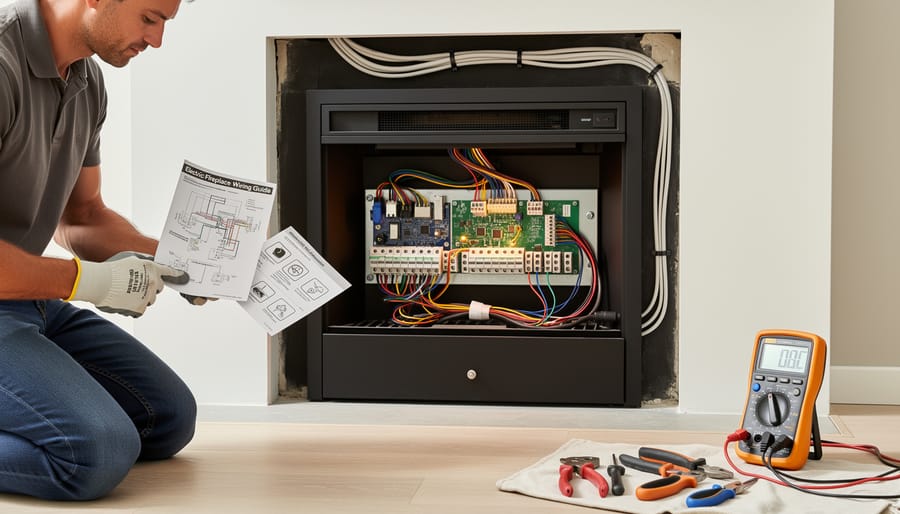
Your electric fireplace’s wiring diagram is like a personalized roadmap for your specific model, and knowing how to find and read it makes installation much smoother. Most manufacturers include this essential document in several convenient places. First, check your owner’s manual, typically in the installation section near the back. You’ll also often find the diagram on a label or sticker affixed to the back or side panel of the fireplace unit itself, usually near where the electrical connections are made.
If you’ve misplaced your physical manual, don’t worry. Visit the manufacturer’s website and search for your model number, which you’ll find on the unit’s identification plate. Most companies offer downloadable PDFs of their manuals, including detailed wiring diagrams.
When examining your diagram, look for these key elements: color-coded wires showing which connections match your home’s electrical system, the required circuit breaker amperage, and whether your model needs dedicated circuitry. You’ll also see symbols indicating ground connections, neutral wires, and hot wires. The diagram should specify voltage requirements, typically 120V or 240V for most residential units.
Take a photo of the diagram with your phone for easy reference during installation. This simple step can save you multiple trips back to check connections, making your project flow more smoothly while keeping safety front and center.
Common Wiring Symbols and What They Mean
Understanding wiring diagrams becomes much easier once you’re familiar with the basic symbols electricians use. Think of these symbols as a simple visual language that helps you bring safe, cozy warmth into your home.
The most important symbols you’ll encounter represent your three main wire types. The hot wire, typically shown as a black line or marked with an “L” (for “live”), carries electricity to your fireplace. The neutral wire, usually white or marked with an “N”, completes the circuit by returning electricity to the power source. The ground wire, often green or marked with a ground symbol (three descending lines or a circle with a line extending downward), provides essential safety protection.
You’ll also see symbols for switches, typically represented by a small circle with a line through it, which control your fireplace’s operation. Thermostat symbols often appear as rectangles or circles with “T” markings, showing where temperature control connects to your system.
Connection points are shown as dots where lines intersect, while lines that simply cross without dots aren’t connected. Junction boxes appear as squares or rectangles where multiple wires meet.
Familiarizing yourself with these symbols helps you understand your specific installation needs and communicate effectively with professionals when needed, ensuring your eco-friendly heating solution is both safe and efficient.
Thermostat and Remote Control Wiring
Many modern electric fireplaces offer the convenience of thermostat controls and remote operation, adding an extra layer of comfort to your cozy setup. The good news? These features typically use low-voltage wiring that’s much safer and simpler to work with than standard electrical circuits.
Most thermostats and wireless remote receivers connect to your electric fireplace using thin, low-voltage wires, usually around 18 to 24 gauge. These wires carry minimal electrical current and simply send signals to turn your fireplace on or off based on room temperature or your preferences. You’ll typically run these from the fireplace unit to your wall-mounted thermostat location, keeping them separate from your main power wiring.
While low-voltage wiring is generally DIY-friendly, placement matters for both functionality and aesthetics. Consider installing your thermostat away from direct heat sources and drafts to ensure accurate temperature readings. Many homeowners choose to run these wires through walls for a clean, professional appearance that maintains your home’s ambiance.
If you’re adding these features to your electric fireplace setup, check your manufacturer’s diagram carefully, as connection points vary by model. This small addition to your wiring plan creates a more efficient, eco-friendly heating solution by preventing your fireplace from running unnecessarily.
Three Wiring Scenarios: Which One Fits Your Situation?
Plug-In Installation (The Simplest Option)
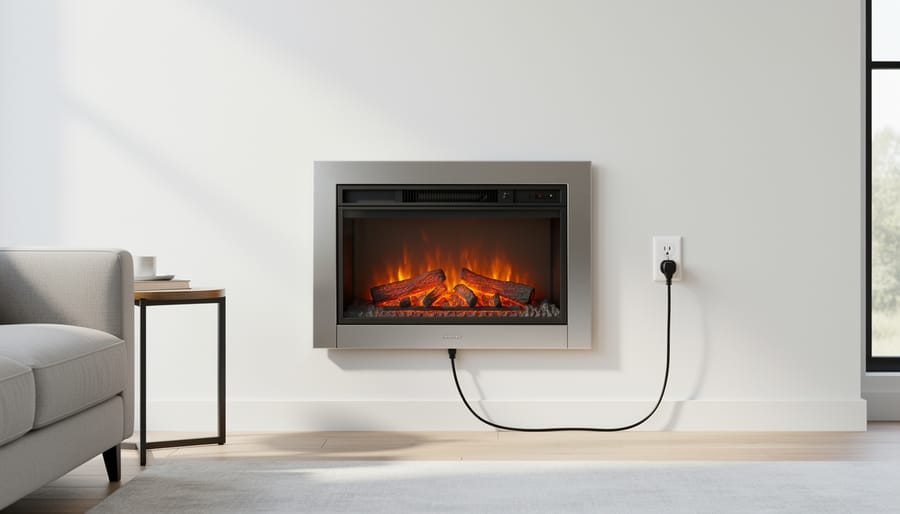
Here’s the wonderful news for most homeowners: if your electric fireplace is rated at 1,500 watts or less, you’re looking at the simplest installation imaginable. These standard units operate on regular 120-volt household current and simply plug into an existing outlet, just like your television or lamp. There’s no complicated wiring diagram to decipher, no electrical panel to access, and typically no need for an electrician.
Before you plug in and enjoy your new fireplace, let’s cover a few essential requirements. First, your outlet must be grounded with three prongs to ensure safe operation. Ideally, your electric fireplace should have a dedicated circuit that isn’t shared with other high-wattage appliances. If your lights dim when you turn on the heater function, that’s a clear signal you’re overloading the circuit.
Here’s a crucial safety warning: resist the temptation to use extension cords, even temporarily. Electric fireplaces draw substantial power when heating, and extension cords can overheat, creating a fire hazard. If your outlet isn’t conveniently located, have an electrician install one closer to your fireplace location.
This plug-in option works beautifully for smaller spaces, apartments, or anyone seeking a lifestyle enhancement without renovation hassles. It’s the eco-friendly choice for supplemental heating, allowing you to warm the room you’re actually using while turning down your central thermostat. The simplicity makes electric fireplaces accessible to everyone who wants to add warmth and ambiance to their home without complicated installation procedures.
Dedicated Circuit Hardwiring
Most electric fireplaces rated above 1,500 watts require their own dedicated circuit, meaning nothing else shares that electrical pathway. Think of it like giving your fireplace its own private highway from the breaker panel to avoid traffic jams that could trip breakers or create safety hazards. If your fireplace draws 12 amps or more, a dedicated circuit isn’t just recommended—it’s essential for both safety and performance.
The wiring path is straightforward but must be done correctly. Power flows from your main electrical panel through a dedicated breaker, travels through walls via properly sized cable, and terminates at either a junction box or hardwired connection point behind your fireplace. This creates a direct, uninterrupted power supply that ensures your fireplace operates at peak efficiency while keeping your home safe.
Wire gauge selection is where many homeowners get tripped up, but it’s actually quite logical. The gauge number works backwards—lower numbers mean thicker wire. For most electric fireplaces, 12-gauge wire paired with a 20-amp breaker handles the load beautifully. Some smaller units might work with 14-gauge wire on a 15-amp circuit, but always check your specific model’s requirements in the installation manual. Using wire that’s too thin for your fireplace’s power needs creates dangerous heat buildup inside your walls—something no one wants.
Here’s the honest truth: while understanding this wiring path helps you make informed decisions and communicate effectively with electricians, installing a dedicated circuit requires working inside your breaker panel. Unless you’re a licensed electrician, this is professional territory. The good news? Knowing these basics means you can ensure the work is done right and choose an eco-friendly setup that efficiently powers your cozy lifestyle upgrade for years to come.
240V High-Power Installations
When you’re installing a larger built-in electric fireplace, you’ll typically need to step up to a 240-volt electrical service. These high-power units, which often range from 4,000 to 5,000 watts, deliver the kind of serious heating capacity that can warm substantial living spaces while creating a stunning focal point for your home.
Unlike standard plug-in models, 240V installations require hardwiring directly to your home’s electrical panel. This means installing a dedicated double-pole circuit breaker, which uses two hot wires instead of one. The wiring diagram for these systems shows three or four wires: two hot conductors (typically black and red), one neutral (white), and a ground wire (bare copper or green). Each hot wire carries 120 volts, but together they provide the 240 volts needed to power these robust units.
The complexity and safety considerations of 240V installations make this a job where professional help truly shines. A licensed electrician will ensure proper wire gauge selection, typically 10 or 8 AWG depending on the amperage requirements and distance from your electrical panel. They’ll also verify that your home’s electrical service can handle the additional load without overloading existing circuits.
While exploring various built-in fireplace options, you’ll find that many manufacturers require professional installation to maintain warranty coverage. This isn’t just corporate policy; it’s a genuine safety consideration. Working with 240V circuits carries serious risks if done incorrectly, including fire hazards and electrical shock. The investment in professional installation pays dividends in safety, performance, and peace of mind, letting you focus on enjoying the warmth and ambiance these magnificent units bring to your living space.
Safety Requirements You Cannot Skip
National Electrical Code (NEC) Basics for Homeowners
Understanding the National Electrical Code doesn’t have to be intimidating. Think of the NEC as a friendly guidebook designed to keep your home and family safe while you enjoy the cozy ambiance of your electric fireplace.
The most important thing to know is that electric fireplaces typically require a dedicated circuit, meaning that circuit should power only your fireplace and nothing else. This prevents overloading, which is a common cause of electrical issues. Most electric fireplaces need either a standard 120-volt, 15-amp circuit or a 120-volt, 20-amp circuit, depending on the unit’s power requirements. Some larger models may require 240-volt circuits.
The NEC also requires proper grounding for all electrical appliances. Your electric fireplace must be grounded to protect against electrical shock. Additionally, any outlets used should be properly rated for the fireplace’s electrical load and installed according to local building codes.
Here’s the really important part: while electric fireplaces are generally safer and simpler than traditional wood-burning options and represent an eco-friendly heating solution, electrical work should always be performed by a licensed electrician if you’re unsure about any aspect. Your local jurisdiction may require permits and inspections for new electrical installations, even for seemingly straightforward projects. When in doubt, consulting a professional ensures your installation meets all safety standards while maintaining your home’s cozy comfort.
Grounding and GFCI Protection
Think of grounding as your electric fireplace’s safety net—it’s the invisible guardian that protects you and your family from potential electrical hazards. When properly grounded, any stray electrical current has a safe path directly to the earth rather than through you. This isn’t just a nice-to-have feature; it’s absolutely essential for safe operation.
Your electric fireplace must connect to a grounded three-prong outlet. That third prong isn’t decorative—it’s your lifeline. Never use an adapter to plug a three-prong fireplace into an ungrounded two-prong outlet. If you’re dealing with older wiring that lacks proper grounding, it’s time to call a licensed electrician to upgrade your electrical system before installing your fireplace.
Now, let’s talk about GFCI (Ground Fault Circuit Interrupter) protection. While not always required for electric fireplaces in living spaces, GFCI outlets become mandatory in certain locations. If you’re installing your cozy heating solution in a bathroom, basement, garage, or within six feet of a water source, you’ll need GFCI protection. These special outlets monitor electrical flow and shut off power in milliseconds if they detect an imbalance—potentially saving lives.
Here’s a real-world scenario: Imagine your electric fireplace develops a small internal fault while you’re adjusting the flame settings with damp hands after watering nearby plants. With proper grounding and GFCI protection, you’d experience nothing more than the outlet clicking off. Without these safeguards, the outcome could be tragically different. This is why cutting corners on grounding simply isn’t worth the risk.
When to Call a Licensed Electrician (And When You Can DIY)
Red Flags That Mean ‘Call a Pro’
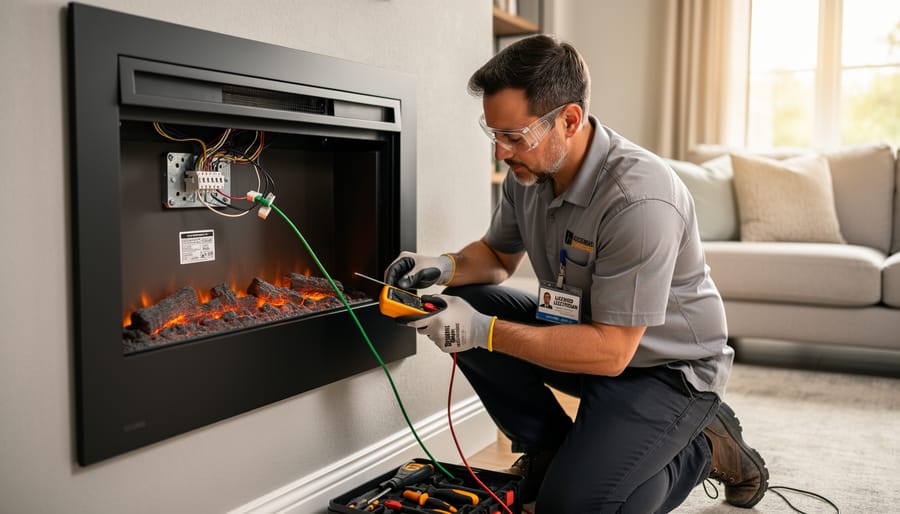
While many electric fireplace installations are straightforward DIY projects, certain situations absolutely require calling a licensed electrician. Your home’s safety is too important to guess.
If your home has old wiring, especially aluminum wiring or cloth-insulated cables common in homes built before the 1970s, a professional assessment is essential. These systems weren’t designed for modern electrical loads and may need updating before adding any new appliances. Similarly, if your electrical panel is already maxed out or you’re still using an old fuse box, you’ll likely need a panel upgrade to safely accommodate your new fireplace.
Don’t have an available circuit for your fireplace? This isn’t a simple fix. Adding new circuits requires working inside your electrical panel, which is dangerous without proper training and equipment. A pro can safely install dedicated circuits while ensuring everything meets current electrical codes.
Speaking of codes, many municipalities require permits and professional installation for any hardwired electrical work. While permit requirements might seem like a hassle, they exist to protect your home and family. A licensed electrician knows local codes inside and out and can handle the permitting process, giving you peace of mind that your cozy new fireplace addition is both safe and legal.
What to Expect From Professional Installation
When hiring a licensed electrician for your electric fireplace installation, you can expect to invest between $200 and $800, depending on your home’s existing wiring and the complexity of the job. Homes that already have a suitable 240-volt circuit nearby will fall on the lower end, while those requiring new circuit installation from the breaker panel will cost more.
Most professional installations take 2-4 hours for straightforward setups, though adding a new dedicated circuit can extend the timeline to a full day. Your electrician will first assess your electrical panel’s capacity to ensure it can handle the additional load without overloading your system. They’ll verify that all connections meet local building codes and National Electrical Code requirements, which is essential for both safety and home insurance purposes.
During installation, expect your electrician to install appropriate circuit breakers, run properly rated wire through walls if needed, and ensure all connections are secure and properly grounded. They’ll also test the system before finishing, giving you peace of mind that your new fireplace will operate safely and efficiently. This professional approach protects your investment and creates a cozy, worry-free addition to your home’s ambiance.
Eco-Friendly Considerations for Electric Fireplace Wiring
Energy-Efficient Installation Practices
When you’re planning your electric fireplace wiring, thinking beyond just getting the unit connected can help you create a truly efficient heating solution for your home. Smart wiring choices today can lead to significant savings and comfort improvements down the road.
Consider running dedicated wiring for a programmable thermostat during installation. This allows you to schedule your fireplace to warm your space only when needed, perhaps heating your living room an hour before you typically arrive home while keeping it off during empty daytime hours. This simple addition can dramatically impact your energy efficiency and costs.
Zone heating is where electric fireplaces truly shine as an eco-friendly solution. By wiring your fireplace on its own circuit, you can heat the rooms you actually use while turning down your central heating system. This targeted approach means you’re not wasting energy warming empty bedrooms or unused spaces.
If you’re installing multiple electric fireplaces throughout your home, work with your electrician to ensure each unit has adequate power without overloading circuits. Proper load distribution prevents efficiency losses and ensures safe operation while giving you flexible control over different zones in your home.
Solar Panel Compatibility
Good news for eco-conscious homeowners: electric fireplaces pair beautifully with solar panel systems! Since these units run on standard household electricity, they can draw power directly from your solar setup just like any other appliance. The wiring process remains essentially the same whether you’re connected to the grid or using solar power.
However, there are a few things to consider. Your solar system’s capacity matters. A typical electric fireplace uses between 1,200 to 1,500 watts, so you’ll want to ensure your solar array and battery storage can handle this additional load, especially during evening hours when you’re most likely to enjoy your fireplace’s ambiance. Consider sizing your system accordingly or using your fireplace primarily during sunny days when solar production is highest.
From a wiring perspective, your electrician should connect the fireplace to your home’s main electrical panel, which integrates seamlessly with your solar system. Some homeowners even install dedicated monitoring to track how much solar energy powers their fireplace, turning every cozy evening into a celebration of sustainable living.
Troubleshooting Common Wiring Issues
Breaker Keeps Tripping
If your breaker keeps tripping when you plug in your electric fireplace, you’re dealing with one of the most common electrical issues homeowners face. The good news? It’s usually straightforward to identify the cause.
Most often, the problem stems from circuit overload. Your electric fireplace draws significant power, typically between 1,200 and 1,500 watts at maximum heat. If other appliances share the same circuit, you’re asking too much from that breaker. Think of it like trying to pour too much water through a single pipe – something’s got to give, and that’s your breaker doing its job to protect your home.
Another common culprit is using an extension cord or power strip, which can’t safely handle the continuous load an electric fireplace requires. These heating units need a dedicated outlet to operate properly.
Sometimes, a faulty heating element or damaged wiring within the fireplace itself causes the trip. If your fireplace keeps shutting off or immediately trips the breaker, there may be an internal short circuit.
Start by unplugging everything else on that circuit. If the breaker still trips with only the fireplace connected, contact a licensed electrician to inspect both the unit and your home’s wiring safely.
Fireplace Won’t Turn On or Works Intermittently
When your electric fireplace refuses to turn on or works sporadically, it’s understandably frustrating, especially when you’re looking forward to that cozy ambiance. Before calling a professional, there are several safe diagnostic steps you can take yourself.
Start with the basics: check if your fireplace is properly plugged in and that the outlet is working. Test the outlet by plugging in another device like a lamp. Next, examine your home’s circuit breaker panel to ensure the breaker hasn’t tripped. Electric fireplaces draw considerable power, and a tripped breaker is one of the most common culprits.
If the power source checks out, look at your remote control or wall switch. Try replacing the remote batteries, as weak batteries can cause intermittent operation. Inspect any visible connections where the power cord enters the fireplace unit, looking for loose plugs or damaged cords.
Check your fireplace’s manual for any reset buttons, typically located on the unit’s control panel. Many models have thermal overload protection that shuts down the unit if it overheats, requiring a manual reset.
If you’ve tried these steps and your fireplace still isn’t cooperating, it’s time to consult a qualified electrician. Issues within the wiring system or internal components require professional expertise to diagnose and repair safely.
Understanding your electric fireplace wiring diagram puts you in control of creating the warm, inviting atmosphere you’ve been dreaming about. While we’ve walked through the essentials together, remember that confidence and caution make the perfect partnership. If you’ve got basic electrical knowledge and your situation calls for a simple plug-in setup, you’re likely ready to move forward. But if anything feels uncertain or your installation requires hardwiring, there’s absolutely no shame in calling a licensed electrician. In fact, it’s the smart choice.
Your electric fireplace represents more than just a heating solution. It’s an investment in your home’s comfort, ambiance, and value. Taking the time to ensure proper installation means you’ll enjoy countless cozy evenings without worrying about safety concerns or code violations. Whether you tackle this project yourself or bring in a professional, the end result is the same: a beautifully functioning fireplace that brings warmth and character to your space for years to come. Do it right, do it safely, and get ready to enjoy the perfect blend of modern convenience and timeless comfort.